Best Mobile App Development Languages: How to Choose the Right One?
Published: Nov 29, 2025
Updated: Dec 02, 2025
Published: Nov 29, 2025
Updated: Dec 02, 2025
If you are searching for mobile app development languages, you are probably feeling overwhelmed. And honestly, I don’t blame you. When I first started building mobile apps, choosing between Java, Kotlin, Swift, Dart, JavaScript, and C# felt like choosing between foreign languages I’d never heard anyone speak.
And with new frameworks launching every year, the confusion hasn’t gone away. I have seen beginners freeze for weeks because they are afraid of picking the “wrong” language, and I have met founders who wasted months rebuilding their apps because they chose the wrong tech stack.
This guide fixes that. Instead of drowning you in jargon, I will break down each language with real-world examples, explain the strengths and weaknesses, and help you decide which language to choose based on:
- Your project
- Your goals
- Your budget
- Your target audience
- Your learning curve
Whether you are a beginner or a startup looking to hire a team, this guide simplifies your decision without the confusion.
Why Choosing the Right Mobile App Development Language Matters?
Most beginners think all languages do the same thing — they don’t. The language you choose affects:
- Development speed
- Hardware access
- Future scalability
- Your job opportunities
- Performance (speed, loading, battery use)
- Your cost (a single codebase vs two separate native apps)
I have personally worked on apps where choosing the wrong language increased development time by 4 to 6 months and doubled the cost. So yes, this decision matters.
Read more: eCommerce Mobile App Development | How to Choose the Right Company?
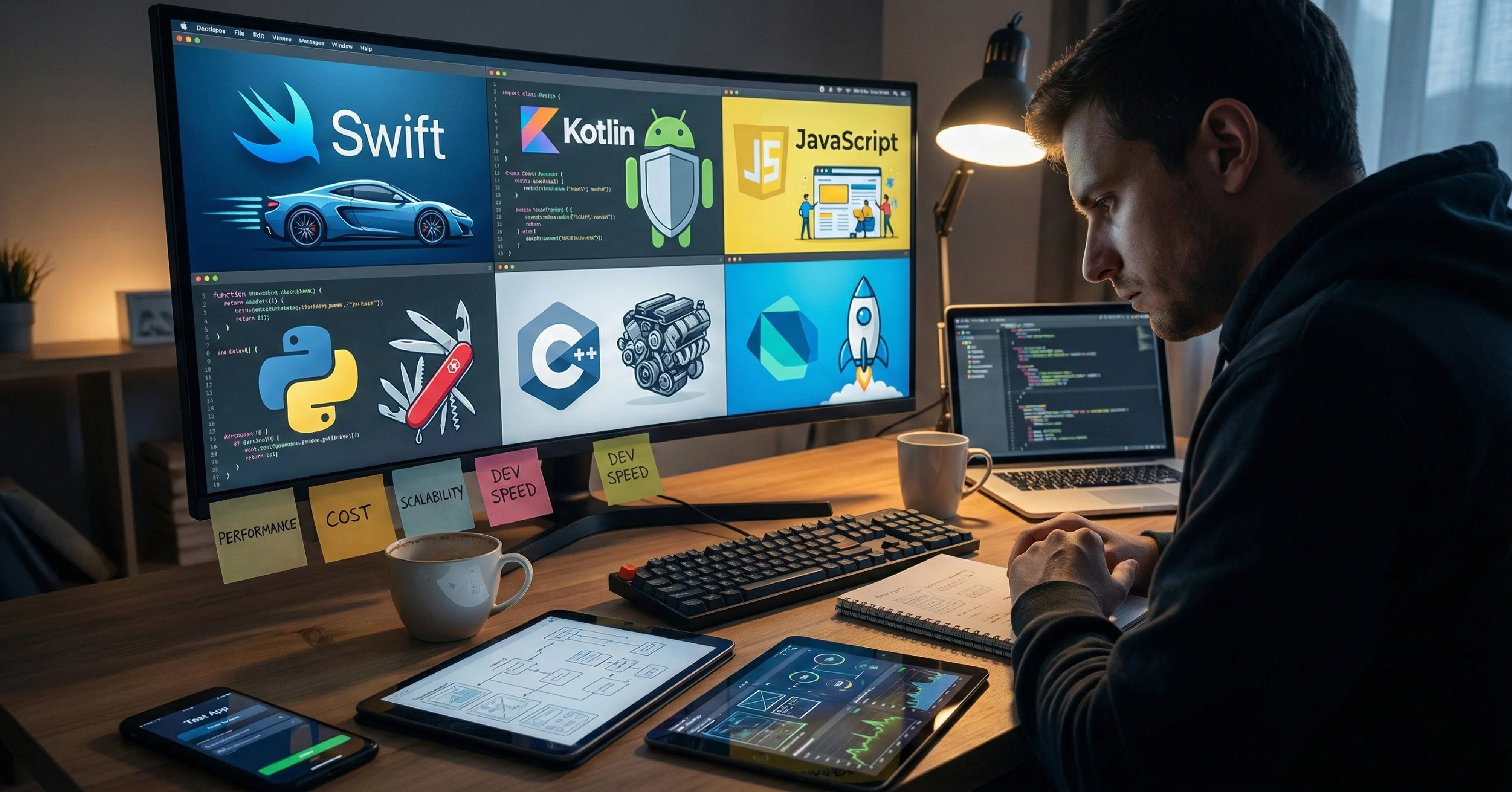
What Beginners Face and What This Article Solves?
1. Too many choices → “Which one should I learn?”
- Java? Kotlin? Swift? Dart? It is overwhelming.
- This guide simplifies everything.
2. Native vs. cross-platform confusion
- Should you build for Android, iOS, or both?
- I will show you how to decide in minutes.
3. Learning curve fears
- Every language feels complicated at first.
- I will break them down in beginner-friendly terms.
4. Performance trade-offs
- Some languages offer speed, others offer convenience.
- You will understand these trade-offs clearly here.
5. Career concerns
- Many beginners don’t want to learn a language no one uses.
- I will explain which languages have strong job demand today.
Also read: WordPress Web Development | Uplift Your Digital Presence

Comparison Table: Best Language for Mobile App Development
Before getting into the detailed specifics, let’s take a quick look at choosing the best programming language to develop mobile apps.
|
Language
|
Best For
|
Platform
|
Difficulty
|
Cross-Platform
|
|
Kotlin
|
Android apps
|
Android
|
Easy
|
Limited
|
|
Java
|
Enterprise Android
|
Android
|
Medium
|
No
|
|
Swift
|
iOS apps
|
iOS
|
Easy
|
No
|
|
Objective-C
|
Legacy iOS apps
|
iOS
|
High
|
No
|
|
JavaScript / React Native
|
Cross-platform
|
Android + iOS
|
Easy
|
Yes
|
|
Dart / Flutter
|
High-performance cross-platform
|
All
|
Easy
|
Yes
|
|
C# / MAUI
|
Enterprise cross-platform
|
Android + iOS
|
Medium
|
Yes
|
|
C++
|
Games/VR
|
Android + iOS
|
High
|
Partial
|
Top 8 Mobile App Development Languages
Let’s go through the most popular mobile app developer languages, including those best suited for Android, iOS, and cross-platform apps.
1. Kotlin – The Best Android Mobile App Development Language
Platform: Android
Used By: Google, Pinterest, Uber
Learning Curve: Beginner-friendly
I still remember shifting from Java to Kotlin. The first thing I noticed? My code became shorter, cleaner, and far less frustrating. Google now calls Kotlin the preferred language for Android, and for good reason.
Strengths
- Modern syntax, fewer bugs
- Fully supported by Google
- Great performance
- Works with existing Java code
Weaknesses
- Android-only (unless using Kotlin Multiplatform)
- Smaller talent pool than Java
Real-World Example
A client app I built with Kotlin reduced 30% of the code compared to its Java version. Bugs dropped dramatically.
Choose Kotlin if you want the best modern language for Android app development.
2. Java – The Classic Powerhouse for Android
Platform: Android
Used By: LinkedIn, Spotify, Netflix
Learning Curve: Moderate
Java may be older, but it is still everywhere. I see companies using Java for long-lived, enterprise-grade apps because it is stable and extremely reliable.
Strengths
- Massive community
- Tons of libraries and tools
- Great for large, complex apps
- Works perfectly with Android
Weaknesses
- Verbose (more code = more work)
- Steeper learning curve than Kotlin
Choose Java if you want to work with enterprise Android systems or maintain older apps.
3. Swift – The Best Language for iOS App Development
Platform: iOS
Used By: Apple, Slack, Lyft
Learning Curve: Easy
When I built my first iOS app, Swift genuinely surprised me. It is clean, fun to learn, and incredibly powerful. Apple designed it to replace Objective-C, and today, most iOS apps rely on Swift.
Strengths
- Fast performance
- Easy for beginners
- Safe syntax reduces errors
- Designed for all Apple devices
Weaknesses
- Limited to the Apple ecosystem
- Smaller community than JavaScript
Real-World Example
I built a finance tracking app in Swift and noticed that animations and transitions ran far smoother compared to cross-platform options.
Choose Swift if you want to build high-quality, native iOS apps with top-tier performance.
4. Objective-C – The Legacy iOS Language
Used For: Maintaining older iOS apps
Objective-C is not a beginner-friendly programming language. But if you are maintaining legacy apps or working for older companies, you will still run into it.
Strengths
- Stable and time-tested
- Still used in older enterprise apps
Weaknesses
- Harder to learn
- Replaced by Swift
Choose Objective-C if your project already uses it and needs updates.
5. JavaScript (React Native) – Best Language to Develop Cross-Platform Mobile Apps
Platform: Android + iOS
Used By: Facebook, Instagram, Tesla
Learning Curve: Easy
If someone told me, “I want to build apps fast and cheap,” I’d recommend React Native. One codebase → two apps.
Strengths
- Saves time and money
- Huge JavaScript developer community
- Easy to learn
- Supports hot reload
Weaknesses
- Not fully native performance
- Requires bridging for certain device features
Real-World Example
I once helped a startup reduce development cost by approximately 40% by switching from separate native apps to React Native.
Choose React Native if you want a cross-platform app without sacrificing too much performance.
6. Flutter(Dart) – Best for High-Performance Cross-Platform Apps
Platform: Android, iOS, Web, Desktop
Used By: Google Ads, Alibaba, eBay
Learning Curve: Beginner-friendly
Flutter is hands-down one of my favorite cross-platform tools. UI looks beautiful, apps run fast, and you can build mobile + web from the same codebase.
Strengths
- Near-native performance
- Gorgeous user interfaces
- Google-supported
- Fast development
Weaknesses
- Larger app size
- Ecosystem still growing
Real-World Experience
I built a prototype app in Flutter in just three days—something that would’ve taken a week in native development.
Choose Flutter if you want the best language to develop cross-platform mobile apps with stunning UI.
Platform: Android + iOS
Used By: UPS, Alaska Airlines
Learning Curve: Medium
Xamarin and now .NET MAUI are strong options for businesses already using Microsoft tools.
Strengths
- Great for enterprise apps
- Access to native APIs
- Supported by Microsoft
Weaknesses
Choose C# if your company already uses .NET or Azure.
8. C++ – Maximum Performance for Games & High-End Apps
Platform: Android + iOS
Used For: Games, AR/VR, engines
Difficulty: High
If you want pure speed, C++ is unmatched. But it is not for beginners.
Strengths
- Extreme performance
- Controls memory management
Weaknesses
- Hard to learn
- Not ideal for standard apps
Choose C++ if you are building gaming, 3D, VR, or graphics-heavy apps.
Which Language Should You Choose? A Simple Approach!
This simple breakdown helps you decide based on your goals.
If you are a beginner:
Start with JavaScript (React Native) or Flutter (Dart).
If you want Android development:
Choose Kotlin.
If you want iOS development:
Choose Swift.
If you want both Android + iOS with one codebase:
Choose Flutter or React Native.
If you are targeting gaming apps:
Choose C++.
If you want enterprise-level development:
Choose Java or C#.
Also read: Custom WordPress Development | Challenges and Best Practices
FAQs
1. Which language is the best for mobile app development?
It depends on what you want to build:
- Android apps: Kotlin
- iOS apps: Swift
- Cross-platform apps: Flutter (Dart) or React Native (JavaScript)
- Games: C++
There is no single best language. It depends on your project’s goals and scope.
2. What is the most popular programming language for mobile app development?
Based on current demand and usage:
- JavaScript (for cross-platform apps)
- Kotlin (for Android apps)
- Swift (for iOS apps)
These dominate the job market and industry adoption today.
Final Thoughts: Don’t Overthink It, Start With Your Goal
The truth is, most beginners spend so much time picking the “best” from a list of popular mobile app development languages that they never start building anything. Every modern language is capable of creating amazing mobile apps. What matters most is:
- Who you are building for (Android, iOS, or both)
- Your timeline and budget
- Your skill level
- Your long-term career plans
If you are still unsure, here is a simple rule I personally follow with new students:
- Start with Flutter if you want to build fast.
- Choose Kotlin or Swift if you want a native career.
Once you master one language, learning others becomes much easier. Do you want to build an Android, iOS, or cross-platform app to make your business stand out? Searching for a reliable mobile app development company? Look no further than KodersPoint.
Share this article and spread the love